Time-traveling with Ideas: An Exploration of Shakespeare’s
“Macbeth”
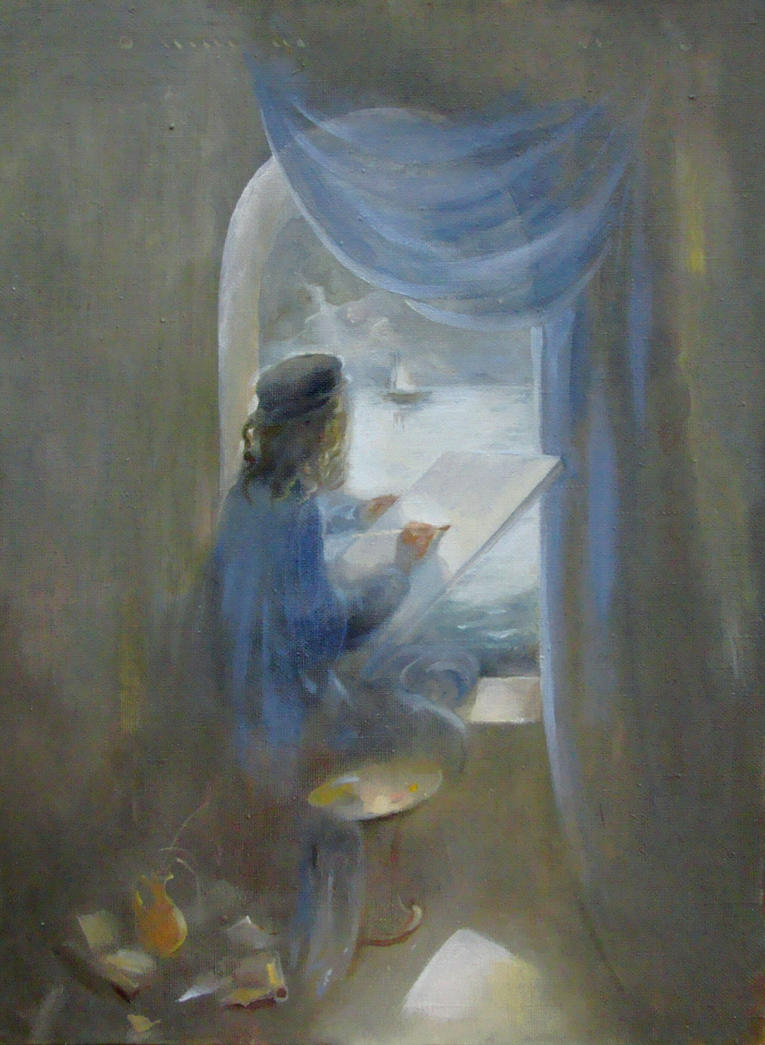
A dagger quivers within the withered grip of a woman—a
retired femme fatale, slowly sinking into the depths of insanity.
Many literary works, although set in a particular place or time,
convey certain ideas or ‘morals’ that are universal. Shakespeare’s
“Macbeth” is a prime example; as he conveys the idea of trust as
an oft-fluctuating object (to be dispensed with a lot of reservation)
and of course, the idea of retribution (or Karma, if you will) as an
omnipresent part of existence. Literary devices, effectively coupled
with detailed human interaction mean that “Macbeth”, despite
being primarily set in Middle-Age Scotland, contains ideas
transcending time, this being true to a great extent of other literary
works as well.
The ideas of trust being a commodity to be bestowed with
reserve, and perhaps the normality of betrayal are propagated
throughout the play. Possibly the most apparent example of this
would have to be between the original king and Macbeth. Macbeth
professes his complete and boundless loyalty to the king, almost
behaving in the manner of a humble servant. Later in the play, he
ends up killing the king by repeatedly stabbing him in order to
dethrone him and assume the role of “ruler”. Yet another instance
of this would have to be between Macbeth and MacDuff
(coincidentally similar names). Having taken over as King, Macbeth
believes that previous King’s staff will have to bear the same
loyalty to him. Though putting on a brave face and regarding
Macbeth with utmost courteousness, MacDuff planned to escape
and make rise to a movement to overthrow Macbeth and reinstate
Malcolm (King Duncan’s eldest son). Here we have instances
where too much trust is emplaced, resulting in a betrayal (the King
and Macbeth), and one where excessive trust is assumed one of the
individuals’ part, resulting in a surprising deceit. Though occurring
in the setting of stringent monarchy and in the time of battles and
relative lawlessness, “Macbeth”- through the effective portrayal of
human relationships and artful use of literary devices (static and
dynamic characters, irony etc.) conveys ideas that are universal.
The idea of retribution, or “Karma” is conceivably the most
propagated “universal theme” throughout the play. The queen,
portrayed by Shakespeare as a Machiavellian, bloodthirsty femme
fatale is the first example that comes to mind. Essentially, she is
majorly culpable for most of Macbeth’s outlandish despotic actions.
She is the one who goes back to bloody the daggers and frame the
drunken guards. Eventually, Lady Macbeth begins to lose her mind
as she sleepwalks, eerily talking about the murders she has
committed and obsessively washing her hands. Not even Neptune’s
great waters could cleanse the blood that tainted her hands. In the
end she dies, hallucinating and without her husband. The same
goes for Macbeth, in terms of sinking into insanity after having
committed an array of unlawful killings. He dies in a rather gory
fashion, having his head severed by the great MacDuff, after finding
out that he was in fact of no woman-born. Hamartia constitutes a
substantial part of “Macbeth”, but looking closely we can observe
that Hamartia and Karma often go hand in hand in literary works
(especially dramatized ones like Macbeth). Shakespeare’s use of
cyclical structure, action and consequence and power as the
protagonist’s hamartia help circulate the idea of retribution
throughout the play. It is quite reminiscent of the quote “For your
sins you will pay, today or later but never neigh” by Walter Moers
in his book The City of Dreaming Books.
The conveyance of transcending ideas of ‘morals’ in literary
works, irrespective of place or time is present to a great extent in
literary work. Though, in order to effectively observe to what extent
universal ideas are community is various literary works we must,
by association, address some other pieces of literature. Before this
is done though, it must be addressed that these ‘ideas’ are more
often found in literary works exploring interactions of living
organisms (generally humans, but sometimes not). This is because,
as readers, empathy occurs majorly when we can associate
elements of another situation to our own existence or experience.
Most of the morals and ideas that we conceive are in relation to
human interactions and human life. Writers need their literary
audiences to be able to empathize with elements of their texts in
order to be emotionally impacted. Now, let us look into some other
works that convey certain universal ideas. Tolstoy’s Anna Karenina,
set in 19th century Russia, contains the ideas of infidelity as a
catalyst to paranoia and doubt, and that of aesthetics and wealth
being the sole guide to ‘high society’. Murakami’s The Wind-Up Bird
conveys the ideas of the importance of friends as a source of
support, as well as that of human beings leading very multi-faceted
lives. Though these ideas are not specifically mentioned within the
texts mentioned, one can deduce their presence through their
recurrence, as well as association to our experience.
Observing the presence of the universal ideas conveyed in
Shakespeare’s “Macbeth”, perhaps the two that immediately come
to mind are that of trust being rare and karma being an
omnipresent constituent of existence. Ideas, irrespective of
relevance, time or place are always communicated to an extent in
literary works, especially those delving into details of human
interaction. Though empathy being an innate virtue if oft
questioned, readers are emotionally impacted by all of these
famous “literary classics” primarily due to the fact that they are
able to draw certain “morals” and overtones from them.
(credits to Deviantart for the picture)

No comments:
Post a Comment